Finding roommates in Toronto is its own unpaid job. You post, you scroll, you meet strangers in cafés, you try to judge in forty minutes whether someone will pay their share in March. Then you all sign one lease and hope. Most of that work exists because of how the lease is structured, not because sharing is hard.
Sharing with two others
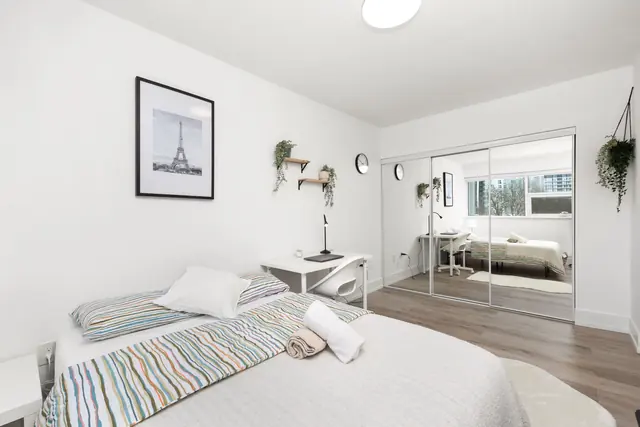
A suite here has three bedrooms. You share the kitchen, the living space and the bathroom with two people; your own room locks and it is yours.
Three is a workable number. There is enough overlap that the place feels lived in, and few enough people that the kitchen is not a queue. The two amenity floors take the pressure off the rest — when three people all need to work at once, somebody can go and sit in the library lounge instead of negotiating for the table.
Matched, not scrolled for
If you apply on your own you are placed by schedule and sleeping hours, not by whichever bed happens to be empty. Somebody on nights and somebody with nine o'clock lectures do not belong in the same suite, and that is knowable in advance.
You can also apply together as a group and take a suite as a set, if you already know who you want to live with.
One rent instead of a bill-splitting group chat
Hydro, heat, air conditioning, water and the internet are in the weekly rate. There is no shared account in one person's name, no monthly reckoning, and no one chasing two other people for their third of a bill in February.
You pay your rent. That is the entire financial relationship you have with the people you live with.
When someone moves out
This is the part worth understanding before you sign anything, anywhere. On a joint lease all the tenants are responsible for the whole rent together — so if one person leaves or stops paying, the rest can be left covering it. A lot of people sign joint leases without being told that.
Leases here are individual. Your name is on your room and nothing else. If a suitemate leaves, we fill the room; it is not your bill and not your search. That single structural difference removes most of the risk people are actually worried about when they worry about roommates.
In this part of the guide
The rest of the field guide
- Rooms for rent — Renting a room
- Student housing — Student housing
- Intern housing — Intern & co-op housing
- Co-living — Choosing co-living
- Furnished rooms — Furnished room for rent