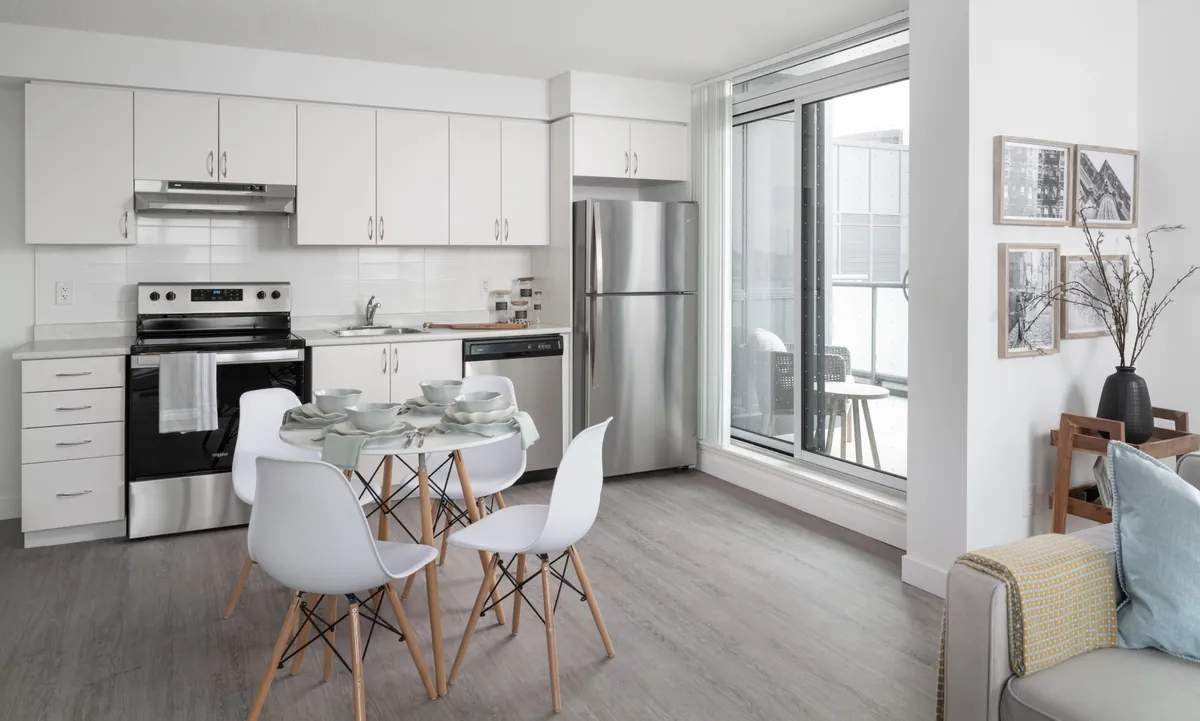
People worry about the bathroom and argue about the kitchen. The bathroom is a sequencing problem with an obvious solution; the kitchen is a shared asset that everyone uses daily, stores things in, leaves things in, and needs at the same hour. If a suite is going to go wrong, this is overwhelmingly where it starts.
The three real friction points
Worth naming precisely, because each has a different fix.
- Fridge territory. The one that generates the most resentment and the least conversation. Unassigned fridge space becomes assigned by whoever shops most aggressively.
- Seven o’clock. One range, three people, one hour when everybody is hungry. This is a scheduling problem that feels like a personality problem.
- The sink. Not washing up is the single most reliable way to make two other people quietly furious, and the threshold for ‘too long’ varies wildly between people.
None of these are about anyone being difficult. They are about three people with different defaults never having said what their defaults are.
What to settle in week one
Four conversations, fifteen minutes total, and they prevent most of what goes wrong in month three.
- Divide the fridge and the cupboards out loud. A shelf each, agreed on day two, settles it permanently. Doing it in month two is a confrontation; doing it in week one is admin.
- Say when you cook. Not a rota — just whether you are a six o’clock person or an eleven o’clock person. Three people usually discover they barely overlap.
- Agree the washing-up rule, and make it a time, not a feeling. ‘Before you go to bed’ is a rule. ‘Don’t leave a mess’ is an opinion.
- Decide what is shared. Oil, salt and washing-up liquid shared; everything else labelled. Ambiguity here is where the first real argument comes from.
What the kitchen itself gives you
Some of this is building design rather than negotiation, and it is worth knowing what you are working with.
The suite kitchen is equipped and has a full-size range rather than the two-ring compromise a lot of shared accommodation runs on — which matters, because most seven-o’clock collisions are caused by there not being enough hob to cook two things at once. There is a dining area, and in several grades a balcony door off it.
Three bedrooms to a suite is the other half of it. The city caps a suite at three, which means a kitchen designed for a family is used by three adults rather than five or six. Most horror stories about shared kitchens are stories about five people, not two.
And the part you do not have to negotiate
One thing that routinely poisons shared kitchens is absent here: the bill.
In a house share, the person who cooks most, runs the dishwasher, or leaves the heating on becomes a line item in somebody else’s grievance, because the hydro bill is split three ways and visible. Here hydro, heat, air conditioning and water are inside the weekly rate. Nobody is monitoring anybody’s cooking, because nobody is paying for it twice.
Leases are individual too, so the financial relationship between the three of you is nil. You share a kitchen, not an account. Rooms start at $220 a week with all of that inside it.
More on roommates
- Together or alone
- One bathroom, three people
- When a suitemate moves out
- Sharing with people on different schedules