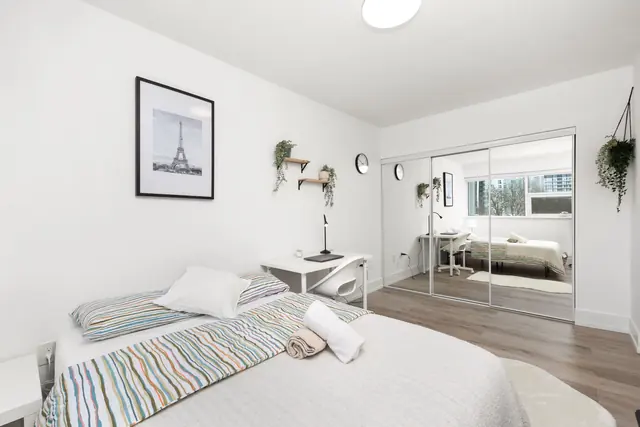
The case against furnished accommodation is straightforward: you are renting furniture every month forever, and buying it once would be cheaper. Over a long enough tenancy that is simply true. The argument is only ever about how long — and the answer is further out than most people assume, because of what happens at the end rather than at the start.
Set the problem up honestly
Call the cost of furnishing an empty room F. A bed and mattress, a desk, a chair, a wardrobe or shelving, a lamp. Use your own number for F, because it varies enormously depending on whether you buy new, buy secondhand, or already own it.
The unfurnished route costs F up front plus a lower monthly rent. The furnished route costs nothing up front and a higher monthly rent. The crossover is where the accumulated rent difference equals F, and the common mistake is to stop the calculation there.
The line people forget is resale
You do not get F back at the end. You get some fraction of it, and the fraction is lower than people expect because everyone is selling the same bed in the same month.
Secondhand furniture in a student city has a seasonal market: in April and August everyone is leaving at once and the price of a used desk collapses. You are also paying to move it — a bed frame does not fit in a car, and the cost of getting rid of furniture is real even when the furniture is free.
So the honest version is F minus whatever you recover, minus the cost of recovering it. Call that the sunk part. For a twelve-month tenancy the sunk part is usually most of F, which pushes the crossover well past a year rather than to the few months the simple arithmetic suggests.
Where that leaves the comparison
Rooms here start at $220 a week, which is $953 a month, and the furniture is inside that — bed, mattress, desk, chair, lamp and wardrobe. So is hydro, heat, air conditioning, water and a minimum 1 Gbps internet line, which is a second set of setup costs the unfurnished route pays separately.
That compounding is the real point. The unfurnished comparison is rarely furniture against furniture; it is furniture plus a hydro account plus an internet install plus a twelve-month term against one weekly figure. The room types page has all six grades if you want to run it against something other than the cheapest.
The short answer
Under a year, furnished wins almost regardless of F. There is not enough time for the monthly difference to catch up, and the sunk part of F lands in full.
Over several years, unfurnished wins — F is paid once and the monthly saving keeps running.
At around twelve months it is genuinely close, and close enough that the deciding factor is usually not money. It is whether you want to spend your first week assembling a wardrobe and your last week trying to sell it. The minimum term here is 4 months, which means you can take the furnished side of this without committing to the year that would make it the expensive choice.
More on furnished rooms
- What to bring to a furnished room
- The kitchen test
- Furnished room vs a monthly short-stay
- Furnished rooms in North York