We are obviously not neutral here, so this is not going to pretend to be a verdict. What it can honestly be is the list of things that decide it — because most people compare one number against one number, and the number is the least decisive of the five. Our side of each line is below. Take the list to the residence office and fill in theirs.
One — how long you are committed
This is the line people check last and regret first. Ask what the residence term actually is, whether it covers the summer, and what leaving mid-term costs.
Residence terms are usually tied to the academic year, which is excellent if your year matches it and expensive if it does not — a January start, a single semester, a co-op term in the middle, a placement that ends in March.
Our side: minimum 4 months, rooms available all year, no academic calendar attached to it.
Two — what is genuinely bundled
Both options advertise inclusive pricing and mean different things by it. Ask specifically: hydro, heat, water, internet. Ask whether the internet is a building network shared by hundreds of people or a line into your unit.
Our side: hydro, heat, air conditioning with a thermostat in each suite, and water are in the weekly rate. The internet is a minimum 1 Gbps line we install and pay for into each unit, shared by its three residents rather than by a floor. Parking is the one genuine extra — an additional monthly charge, limited spaces, worth asking about when you apply.
Three — meals, and whether you want them
Residence often bundles a meal plan, which is a real convenience and a real cost, and the honest question is whether you will use it. If you cook, a meal plan is money spent on a kitchen you are not using. If you will not cook under exam pressure, it is money that stops you living on instant noodles for a month.
Our side: no meal plan. Each suite has an equipped kitchen with a full-size range, shared by the three residents, and there are groceries within a short walk along Finch. That is a lower cost and more of your own work — which is the right trade for some people and the wrong one for others.
Four — the room, and five — what happens in May
On the room: ask how many people share, whether your room locks, whether there is a desk you can actually work at, and whether you can control the temperature. A shared bedroom and a private bedroom are different products at similar prices and the listing rarely leads with which one it is.
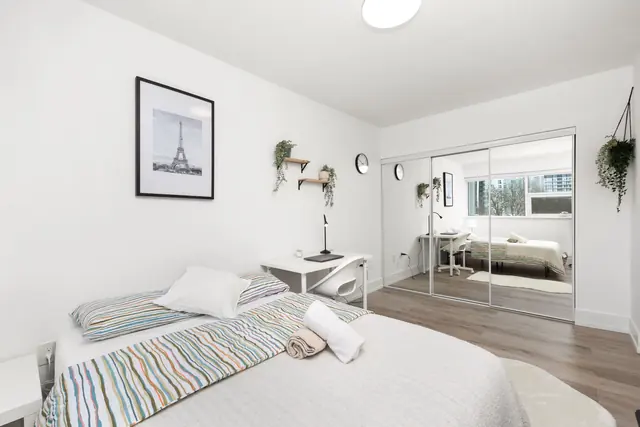
Our side: your own locking bedroom, never a shared one. Three bedrooms to a suite — the city caps it there. A desk, chair, wardrobe and a thermostat in the suite. The room types page has all six grades with what changes between them.
On May: ask what happens at the end of the academic term, where your things go over the summer, and whether you have to reapply for the autumn. For a lot of students this is the hidden annual cost of residence — moving out and back in every year, twice the logistics, storage in between.
Our side: the term is whatever you signed. If you are staying, you stay, and nothing moves in May.
More on student housing
- Winter semester housing
- Still looking for September
- Your first Toronto lease from abroad
- Humber College off-campus housing