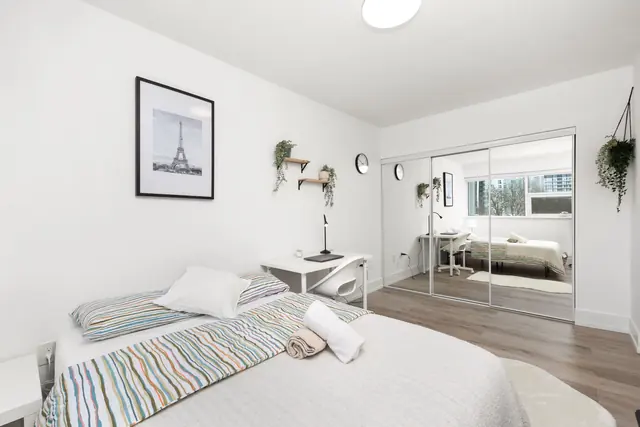
Most people weighing a room against a studio compare two monthly figures and pick the lower one, or decide the gap is worth paying for privacy. Both are reasonable instincts and both are working from the wrong number, because an advertised studio rent is the start of its cost rather than the whole of it. This is not an argument that one wins. It is the arithmetic that lets you decide which.
What a studio adds after the rent
Five lines, in roughly the order they arrive.
- Hydro, and sometimes heat and water. An account in your name, a deposit in some cases, and a bill that is highest in the months you can least afford it.
- Internet. An install appointment, often a term contract, and a monthly line for the whole tenancy.
- Furniture. An empty studio needs a bed, a desk, a chair and somewhere to put things. You either carry that cost or you resell it at a loss when you leave.
- Kitchen and household basics. Pots, plates, a kettle, a bin. Individually trivial, collectively a week’s rent.
- The term. Usually twelve months, which is a cost if you need eight.
None of these are hidden. They are simply not in the figure on the listing, and they are what makes two superficially close numbers diverge.
What the room side of the comparison is
Rooms here start at $220 a week, which is $953 a month on the honest conversion of 52 weeks over 12.
Inside that: hydro, heat, air conditioning with a thermostat in each suite, water, a minimum 1 Gbps internet line we install and pay for, and the furniture. Nothing to open, nothing to install, nothing to resell. The one-off amounts are $200 processing when you apply and $150 key deposit at signing which comes back with the keys, plus first month’s rent, and beyond that last month's rent if you are approved without a guarantor.
The minimum term is 4 months rather than twelve, which is the line that matters most if your reason for being in Toronto has an end date.
What you give up, stated plainly
The studio wins on one thing, and it is not a small thing: you are the only person in it.
Here, your room locks and is yours, but the kitchen, the living space and the bathroom are shared with the two other residents of the suite. Three bedrooms to a suite — the city caps it there — so it is two other people and not five. The highest grade adds a private toilet and hand basin, but the shower is shared in every grade without exception.
If total solitude is the requirement, a studio is the answer and no arithmetic changes that. The room types page shows how much privacy each grade actually buys, which is the more useful question than whether to share at all.
Which one wins, and when
The studio wins if you are staying years rather than months, already own furniture, and value being alone above the cost of being alone. Over a long tenancy the setup costs amortise and stop mattering.
The room wins if your stay has an end date, if you are arriving from another city or country with what fits in a case, or if you want one predictable figure instead of a rent plus four variable lines. The shorter the stay, the more decisively it wins, because setup costs do not amortise over four months — they just sit there.
The honest summary: a studio is cheaper to live in and more expensive to start. Which half of that sentence matters depends entirely on how long you are staying.
More on rooms for rent
- The quiet season
- What the rent does not cover
- A room in a house vs a managed building
- Weekly vs monthly rent: how to compare